Sequence
As an Amazon Associate I earn from qualifying purchases.
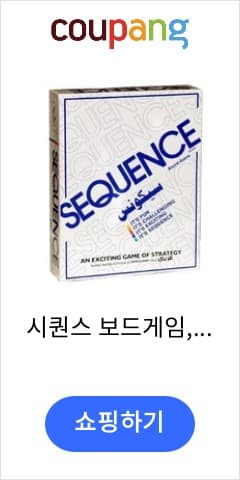
A modern classic that elegantly combines playing-card suits with a five-in-a-row/bingo system. Playing solo or in teams, players place their chips on the board to build an unbroken line of five — a 'sequence' — in this widely popular set-collection and placement party game. On your turn, play a card from your hand and put a chip on the matching space; simple as that. But in team play, teammates can't share their hands and have to read each other's intent purely through where chips land on the board. The constant interplay between timing the powerful wild jack cards — which can go anywhere — and cutting off the opposing team's line makes this a fantastic game.
As an Amazon Associate I earn from qualifying purchases.
※With 2 players or an awkward non-team 3 players, the loud, back-and-forth interference and jack-card energy of a proper team match drops off sharply. Skip it if the game gets dominated purely by draw luck, forcing someone to just watch an opponent run away with it because they never draw what they need, or if a Euro strategy fan wants to win purely on skill and precise design.
RULES
- Goal
- Line up 5 chips of your color in a row, column, or diagonal to complete a sequence.
- Flow
- Play a card from your hand and place a chip on the matching space on the board.
- Win
- First team to complete 2 sequences (in a 2-team game) or 1 sequence (in a 3-team game) wins.
- Twist
- Two-eyed jacks place a chip anywhere; one-eyed jacks remove one opposing chip.
RULES VIDEO
Scores by situation
New faces+−
♡♡♡♡☆ [Safe bet] Rules explain in 2 minutes flat, and the globally proven bingo/five-in-a-row base means total board game newcomers or a couples' gathering sync perfectly the moment you explain it. It has almost universal appeal, and teaming up tightly to laugh and chat together makes it a rock-solid, can't-fail icebreaker for a stiff first meeting.
Close friends+−
♡♡♡♡☆ [Sure thing] Gathering 4 or 6 players for a 2v2 or 3v3 team match makes the comedy tension and dopamine explode. A teammate placing a chip exactly where you needed without a word exchanged shows perfect chemistry, or snatching away the enemy team's winning line with a jack card raises blood pressure in the best way — the cheers and rage-inducing satisfaction are a guaranteed sure thing.
Strategy+−
♡♡☆☆☆ [Out of its weight class] The rules are so simple that whether you draw the card matching the space you want makes up over half the game. For a mid-level strategist crowd expecting deep resource management or precise infrastructure design, the depth feels too shallow and dry — even as a bridge game it can feel underwhelming.
Couple+−
♡♡♡♡☆ [Peaceful weekend] Played 2-player, without the team variable it turns into a clean, tense five-in-a-row style duel. There's constant interaction blocking each other's lines, but the system is so intuitive and lean that it's perfect for a couple to quietly turn their brains on and spend a cozy evening together.
Duel+−
♡♡♡☆☆ [One-shot showdown] Head-to-head, there's plenty of tactical fun. But rather than the deep mind games and suffocating pressure of something like 7 Wonders Duel, the outcome often comes down to how well your card draws cooperate, so it's better as a light warm-up round for a coffee-money bet than a serious showdown.
Gateway+−
♡♡♡☆☆ [Solid gateway] The primal fun of playing cards and placing pieces to build a line, plus the satisfaction of learning the rules, is solid. But the system leans on classic bingo grammar, so it doesn't teach the organic resource management and buildup satisfaction of a modern Euro strategy game, making it a bit lacking in character as a stepping stone toward strategy games.
Frequently asked questions
How many players does Sequence need?
2–12 players, and it is at its best with 4. It also works as a two-player game.
How long does a game of Sequence take?
About 20–30 minutes per game, plus roughly 5 minutes to teach the rules.
Is Sequence hard to learn?
It sits at 2 out of 5 on rules weight. The balance is 50 luck / 30 skill / 20 read, so luck swings enough that a weaker player can still win.
Who is Sequence good for?
It fits New faces and Close friends especially well. One caveat: With 2 players or an awkward non-team 3 players, the loud, back-and-forth interference and jack-card energy of a proper team match drops off sharply. Skip it if the game gets dominated purely by draw luck, forcing someone to just watch an opponent run away with it because they never draw what they need, or if a Euro strategy fan wants to win purely on skill and precise design.
How do you win Sequence?
First team to complete 2 sequences (in a 2-team game) or 1 sequence (in a 3-team game) wins. The goal is Line up 5 chips of your color in a row, column, or diagonal to complete a sequence.
If you liked this one
Played it?
Rate a game and we will lean your picks toward what you like.