Tichu
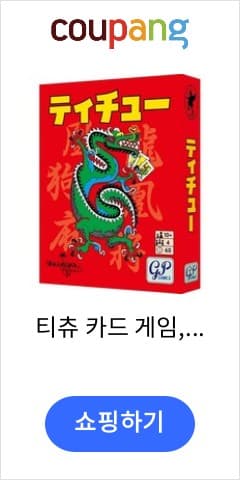
As an Amazon Associate I earn from qualifying purchases.
Players pair up 2-on-2 with a partner across the table, reading each other's unspoken cues, using four powerful special cards (Dragon, Phoenix, Dog, Mahjong) to play card combinations (singles, pairs, straights, etc.) and empty their hand first — and depending on your hand, you can declare "Tichu" to gamble for a big bonus score or risk a penalty — a globally addictive 2-on-2 team climbing card game.
As an Amazon Associate I earn from qualifying purchases.
※When a player feels heavy pressure and stress from the "2-on-2 joint responsibility" system, where one small misplayed card or a hasty Tichu call can doom the entire team (a scoring disaster). Or when a beginner in the mix can't intuitively grasp the complex exception rules of the four special cards — the Mahjong's number designation, the Dragon's trick-passing direction, the Phoenix's resource-cost rules — and keeps breaking the game's fast flow every turn, asking "can I even play this card right now?" Also when even a single player's mental state easily crumbles and they check out of the round when the deal skews the game heavily one way, saying "my hand is trash, there's nothing I can do."
RULES
- Goal
- Team up with your partner to reach 1000 points first
- Flow
- Play card combinations to win tricks and empty your hand first
- Win
- The team to reach 1000 points first wins
- Twist
- After checking your cards but before playing, you may declare Tichu in advance to bet points
RULES VIDEO
Scores by situation
New faces+−
♡☆☆☆☆ [First-meeting explanation wall] It looks similar to poker hands, but fully teaching the Mahjong's declaration rule, the Dog's turn-passing, the Dragon's trick transfer, and the Phoenix's joker usage and scoring — the complex, tricky exceptions of the four special cards — takes enormous time. At a first meetup, everyone's brainpower can get drained just from the rules explanation, and blanking out right at the card-passing/exchange phase easily leads to an awkward silence.
Close friends+−
♡♡♡☆☆ [Friendship-breaking, dead-serious tension] Even close friends will find the weight of joint responsibility too heavy for light, laughing fun. If your partner-friend gets their hand tangled and recklessly calls a "Grand Tichu" only to eat a 200-point penalty, or a mismatched signal during a card pass causes a disaster, a destructive feedback loop of real resentment and arguing can easily spin up. This leans more toward a tense, austere sports tension than a fun entertainment vibe.
Strategy+−
♡♡♡♡☆ [A strategist's ultimate destination] It looks like a simple hand-emptying game, but the depth of card-counting — comparing what's been played against your own hand to perfectly deduce the remaining high-value cards — is immense. You get to taste the essence of 2-on-2 tactical play, communicating with your partner purely through glances and the tempo of played cards to deliver the perfect assist. It has a magic that pulls mid-level strategists away from other heavy Euro games to keep the table running all night — a god-tier bridge-genre game.
Couple+−
♡☆☆☆☆ [A peace-shredder for couples] Since this is a dedicated 2-on-2 team game, a couple wanting to play at one table needs to bring another couple or add two other players. Worse, if you're on the same team and one person's mistake blows the round, it can spiral into a late-night couples' debate (or fight), asking "why did you play that there?" or "didn't you see my hand?" — the worst possible landmine for a cozy couples' game.
Duel+−
♡☆☆☆☆ [Locked to 4 players] Every system, card balance, and partnership structure in this game is precisely carved for exactly 4 players. Variant rules for 3 or 5-6 players exist, but they completely break the fine-tuned 2-on-2 cooperation and counting charm that is Tichu's core, so it's an unwritten rule to never pull this out unless exactly 4 people are gathered.
Gateway+−
♡♡♡♡♡ [Level 5 (best gateway game)] For dedicated newbies determined to go beyond a simple party game and experience the essence of breathless team play and card control that feels like sharing a brain with your partner, this delivers unmatched intellectual thrill and addictive appeal. The chill of sniping an opponent with the Mahjong, having your partner steal a trick with the Dragon, and finally emptying your hand first for a "Tichu grand slam" is a sensation unmatched in board game history.
Frequently asked questions
How many players does Tichu need?
4 players, and it is at its best with 4.
How long does a game of Tichu take?
About 30–60 minutes per game, plus roughly 30+ minutes to teach the rules.
Is Tichu hard to learn?
It sits at 5 out of 5 on rules weight. The balance is 30 luck / 50 skill / 20 read, so the stronger player usually wins.
Who is Tichu good for?
It fits Gateway and Strategy especially well. One caveat: When a player feels heavy pressure and stress from the "2-on-2 joint responsibility" system, where one small misplayed card or a hasty Tichu call can doom the entire team (a scoring disaster). Or when a beginner in the mix can't intuitively grasp the complex exception rules of the four special cards — the Mahjong's number designation, the Dragon's trick-passing direction, the Phoenix's resource-cost rules — and keeps breaking the game's fast flow every turn, asking "can I even play this card right now?" Also when even a single player's mental state easily crumbles and they check out of the round when the deal skews the game heavily one way, saying "my hand is trash, there's nothing I can do."
How do you win Tichu?
The team to reach 1000 points first wins The goal is Team up with your partner to reach 1000 points first
If you liked this one
More ways to choose
Played it?
Rate a game and we will lean your picks toward what you like.