Patchwork
As an Amazon Associate I earn from qualifying purchases.
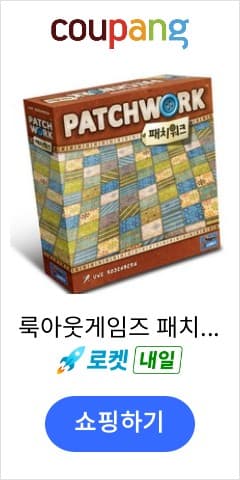
A world-renowned two-player-only puzzle board game where players gather colorful fabric scraps to complete their own beautiful quilt. Players spend 'buttons' — the shared currency and score-defense resource — and limited 'time' to buy Tetris-shaped patch tiles and place them on their personal board. In a unique time-flow mechanism where whoever is behind on the time track keeps taking turns, players must piece together the most beautiful, gap-free quilt possible — a true masterpiece.
As an Amazon Associate I earn from qualifying purchases.
※That moment when you fail to place your tiles efficiently, your board ends up riddled with holes by the time the time track runs out, and your hard-earned button score gets slashed -2 points per empty square, leaving you staring at a brutal negative score in despair. Or when your opponent, eyeing the remaining shape of your board, snipes the one specific tile you absolutely need from the market first — completely derailing your plan and forcing you to sit idle, watching time slip away without picking up a single tile.
RULES
- Goal
- Build a quilt to collect the most buttons
- Flow
- Whoever is behind on the time board buys a patch or takes buttons
- Win
- When time runs out, score buttons minus 2 points per empty square
- Twist
- Buying a tile advances your time token, so whoever's behind keeps taking turns
RULES VIDEO
Scores by situation
New faces+−
♡☆☆☆☆ [First Meeting: No Groups] The rule "pick up a fabric piece and place it on your board without leaving gaps" is intuitive and straightforward enough for anyone to grasp instantly. But since it's built strictly as a two-player game, it's essentially useless at a first meetup of three or more, and it can't be used at all to break the ice in a larger, chattier group.
Close friends+−
♡☆☆☆☆ [A Quiet Knitting Session for Two] This is the exact opposite of a lively party mood where a big group of close friends shouts and bursts with dopamine. It's just the two of you sitting in silence, rotating tiles and calculating empty squares in a static tension that lasts the whole game — not a fit for a lively, energetic gathering of close friends.
Strategy+−
♡♡☆☆☆ [A Light Bridge for Strategists] The mind games of syncing the time track within a single square to grab consecutive turns, and optimizing your button income, give Euro gamers a nice bit of fun. But since the game's volume and pacing are quite light and short, it's used less as a main dish for hardcore strategists pulling an all-nighter and more as a stepping-stone game to clear your head between heavier titles.
Couple+−
♡♡♡♡♡ [A Cozy, Pretty Quilting Date] There's no better game for a couple to enjoy quiet, warm, sociable conversation over a cup of tea. The visual joy of fitting together cute button tokens and colorful patch tiles is huge, and with no elements that directly attack or destroy your partner's progress, it's a perfect masterpiece for creating a soft, relaxing, healing mood between a couple.
Duel+−
♡♡♡♡☆ [A Silent Tile-Sniping Rivalry] Despite its peaceful appearance, when two competitive rivals sit down, it transforms into a fierce territorial battle that won't concede even a single square. You'll snatch away the perfect tile your opponent has their eye on just before they can grab it to fill their board's gap, and seize control of the time track's initiative while they're busy buying an expensive tile — a satisfying, nail-biting mind game.
Gateway+−
♡♡♡☆☆ [Tier 3 (Average / Solid)] An excellent textbook for introducing the Tetris-style puzzle of efficiently filling 2D space and basic resource management. It's ideal for giving eager, dedicated newbies a taste of board games' cute charm and the fun of planning ahead, but there's a bitter sting in the late game when you run out of room to place tiles and get hit with a bomb of empty-square penalties (-2 each), sinking into a negative score — so I recommend it at an average level.
Frequently asked questions
How many players does Patchwork need?
2 players, and it is at its best with 2. It also works as a two-player game.
How long does a game of Patchwork take?
About 20–30 minutes per game, plus roughly 5 minutes to teach the rules.
Is Patchwork hard to learn?
It sits at 2 out of 5 on rules weight. The balance is 10 luck / 65 skill / 25 read, so the stronger player usually wins.
Who is Patchwork good for?
It fits Couple and Duel especially well. One caveat: That moment when you fail to place your tiles efficiently, your board ends up riddled with holes by the time the time track runs out, and your hard-earned button score gets slashed -2 points per empty square, leaving you staring at a brutal negative score in despair. Or when your opponent, eyeing the remaining shape of your board, snipes the one specific tile you absolutely need from the market first — completely derailing your plan and forcing you to sit idle, watching time slip away without picking up a single tile.
How do you win Patchwork?
When time runs out, score buttons minus 2 points per empty square The goal is Build a quilt to collect the most buttons
If you liked this one
More ways to choose
Played it?
Rate a game and we will lean your picks toward what you like.