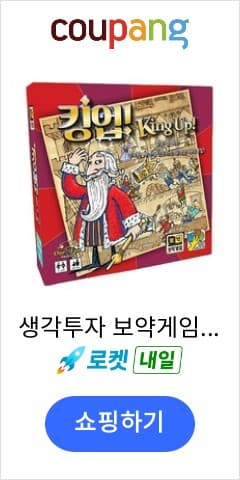
King Up!
As an Amazon Associate I earn from qualifying purchases.
A classic bluffing and read-the-room game where you must raise the ranks of the characters on your secret objective card step by step, ultimately seating them on the throne for a big score. On your turn, players move any character up one floor; the moment someone reaches the throne (the 10-point space), a "coronation vote" is triggered immediately. A king is born — and the game ends — only if every player votes yes, but a single "no" vote (X) from anyone ruthlessly eliminates (executes) that character. The charm lies in slyly hiding your identity while baiting and burning through your opponents' powerful veto votes in a sly psychological duel.
As an Amazon Associate I earn from qualifying purchases.
※With peace-loving players who get personally hurt, deeply uncomfortable, or fatigued by the "direct trolling and politicking" system of mutual suspicion, lying, deceiving, and ruthlessly cutting down an opponent's key card through voting — or with users who'd rather win through static, fully quantified, fully controlled calculation than an emotional psychological duel of reading faces and catching bluffs.
RULES
- Goal
- Raise your secret objective's characters to the castle's higher floors to crown them
- Flow
- Each turn, move a character up one floor; everyone votes on any throne candidate
- Win
- After three rounds, whoever has the highest sum of character-position scores wins
- Twist
- A single "no" vote instantly eliminates that throne candidate from the round
RULES VIDEO
Scores by situation
New faces+−
♡♡♡♡♡ [Crowd-pleaser] The rules explanation is simple and clear enough to finish in 3 minutes, and the intuitive tactile joy of stacking character pieces onto the three-dimensional castle component is excellent. There's no better icebreaker for a first meeting or an awkward couples' hangout. At the voting stage, lines like "Wait, you're voting NO on this?!" or "The culprit is among us!" instantly break the ice and kick off loud, lively chatter.
Close friends+−
♡♡♡♡☆ [Sure bet] A true showcase of backstabbing when playing with close friends. Pretending to ally, then dropping a decisive no-vote at the crucial moment to send a friend's ace character to the guillotine — the fun trolling erupts constantly. A guaranteed sure bet of raw, unfiltered entertainment dopamine, full of mutual suspicion and playful scapegoating.
Strategy+−
♡☆☆☆☆ [Out of its weight class] Doesn't suit a group of intermediate strategists at all who enjoy precise build-up, fully controllable resource allocation, and tight engine optimization. Since it's a party game entirely dependent on reading opponents' psychology, shameless acting, collusion, and voting timing, there's no real reason for a table craving hardcore mental math to pick it.
Couple+−
♡☆☆☆☆ [Built for groups] The core driving force of the game is a multiplayer psychological duel — everyone eyeing each other, suspecting whose character is whose, and carefully spending a limited supply of no-votes. Since it's designed from the ground up for at least 3 players (5-6 is best), the voting mechanism collapses entirely at two players, leaving no real merit to running it as a duo.
Duel+−
♡☆☆☆☆ [Built for groups] In a strict one-on-one setup, you're forced into voting no every time just to check your opponent, leading to a monotonous flow where the game's signature twists and voting tension never materialize. It's simply the wrong answer for a rivalry match meant to draw out tactical psychological play or precise chip-fighting between two competitive players.
Gateway+−
♡☆☆☆☆ [Why now?] A top-tier card for teaching instant laughter and the thrill of deceiving others, but it belongs to a completely different genre from the 'textbook satisfaction of a strategy board game' — managing resources systematically and understanding a system to earn victory. For a newbie dreaming of strategy-game entry, it falls short in mechanically passing on anything meaningful as a stepping stone.
Frequently asked questions
How many players does King Up! need?
3–6 players, and it is at its best with 5.
How long does a game of King Up! take?
About 20 minutes per game, plus roughly 1–3 minutes to teach the rules.
Is King Up! hard to learn?
It sits at 1 out of 5 on rules weight. The balance is 20 luck / 20 skill / 60 read, so quick reads and table sense decide it.
Who is King Up! good for?
It fits New faces and Close friends especially well. One caveat: With peace-loving players who get personally hurt, deeply uncomfortable, or fatigued by the "direct trolling and politicking" system of mutual suspicion, lying, deceiving, and ruthlessly cutting down an opponent's key card through voting — or with users who'd rather win through static, fully quantified, fully controlled calculation than an emotional psychological duel of reading faces and catching bluffs.
How do you win King Up!?
After three rounds, whoever has the highest sum of character-position scores wins The goal is Raise your secret objective's characters to the castle's higher floors to crown them
If you liked this one
Played it?
Rate a game and we will lean your picks toward what you like.