GembloQ
As an Amazon Associate I earn from qualifying purchases.
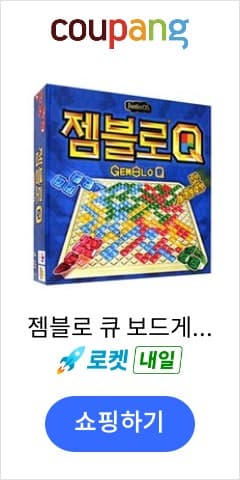
An abstract territory-expansion game played on square grid boards, where each player starts from a corner and extends their territory toward the center by placing their own tiles so they only ever touch at corners (never edge to edge) — the player left holding the fewest squares of tiles wins.
As an Amazon Associate I earn from qualifying purchases.
※Best avoided with someone who has a hard time stomaching the brutal bad-luck moment where, with their giant final tile ready for a comeback play, the player right before them — with no idea of that plan — places a tile somewhere random that happens to perfectly seal their one remaining connecting corner, leaving them stuck holding a pile of huge tiles they can't place and taking a crushing penalty.
RULES
- Goal
- Place as many of your own colored blocks on the board as possible to minimize leftover pieces.
- Flow
- Chain your own blocks together so they only touch at corners, never edges.
- Win
- When no one can place any more, whoever has the fewest leftover blocks wins.
- Twist
- Your blocks can touch opponents' blocks edge to edge, but never your own.
RULES VIDEO
Scores by situation
New faces+−
♡♡☆☆☆ [First-Meeting Barrier] The rule itself — 'place so only corners touch' — takes a single minute to explain. But since you'll be tightly blocking others' paths and squeezing into gaps right from the start, it's a sharp, territorial fight that can leave a first-time group's conversation feeling tense or too quiet rather than warm and easygoing.
Close friends+−
♡♡♡♡♡ [Dopamine Explosion] For close friends dropping in for a quick session, few games are this deliciously spiteful and dopamine-charged. Sneaking a corner into a friend's territory just as they think 'this area is mine' and turning it into rubble, or ruthlessly cutting off their last remaining space, guarantees the screams and laughter close friends live for.
Strategy+−
♡♡☆☆☆ [Strategist's Bridge] A 100% skill-based abstract strategy game with zero luck involved. But rather than drawing out a long-term tech tree, it leans more on the physical spatial-reasoning skill of finding the optimal angle to slot a tile in each turn, so among intermediate strategists who prefer deep, heavy Euro weight, it mostly gets used as a bridge game.
Couple+−
♡☆☆☆☆ [Couples' Goodwill Loss Zone] The complete opposite of the cozy charm of a couple facing each other, peacefully decorating their own space, and healing through quiet conversation. It carries direct aggression — you have to cut off and trap your opponent's paths to win — so it's not recommended for a comfortable time as a couple.
Duel+−
♡♡♡☆☆ [Two-Player Rival Duel] Two-player runs tight and excellent. With more open board space, you get a real duel flavor as you precisely count each other's movement and battle it out. Still, compared to the party-like tension of surviving amid ever-shifting path obstructions from all sides in a four-player game, it's a somewhat drier mind-battle.
Gateway+−
♡♡♡♡☆ [Level 4 (Recommended)] The rules are extremely simple yet still deliver an intuitive taste of the refined game design around 'spatial awareness' and 'claiming territory through corner connections.' A great textbook and recommended pick for an eager new player, delivering the essence of abstract-strategy rivalry and the intellectual thrill of successfully slotting in that final tile.
Frequently asked questions
How many players does GembloQ need?
2–4 players, and it is at its best with 4. It also works as a two-player game.
How long does a game of GembloQ take?
About 20–30 minutes per game, plus roughly 5 minutes to teach the rules.
Is GembloQ hard to learn?
It sits at 2 out of 5 on rules weight. The balance is 0 luck / 70 skill / 30 read, so the stronger player usually wins.
Who is GembloQ good for?
It fits Close friends and Gateway especially well. One caveat: Best avoided with someone who has a hard time stomaching the brutal bad-luck moment where, with their giant final tile ready for a comeback play, the player right before them — with no idea of that plan — places a tile somewhere random that happens to perfectly seal their one remaining connecting corner, leaving them stuck holding a pile of huge tiles they can't place and taking a crushing penalty.
How do you win GembloQ?
When no one can place any more, whoever has the fewest leftover blocks wins. The goal is Place as many of your own colored blocks on the board as possible to minimize leftover pieces.
If you liked this one
More ways to choose
- Board games for close friends→
- Board games for 4 players→
- Board games with a medium rules load→
- Board games that finish in 30 minutes→
Played it?
Rate a game and we will lean your picks toward what you like.